The Role of OEM/ODM Juice Manufacturers in the Global Market

    In today’s highly competitive beverage industry, global brands are under constant pressure to innovate faster, optimize costs, and adapt to rapidly changing consumer preferences. As a result, more brands are turning to juice manufacturers with OEM/ODM solutions as strategic partners rather than traditional suppliers.

    This article explores the role of OEM/ODM juice manufacturer in global beverage supply chains, key capabilities to look for, current market trends, and how the right manufacturing partner can help global brands succeed in diverse markets.

    Global juice market overview

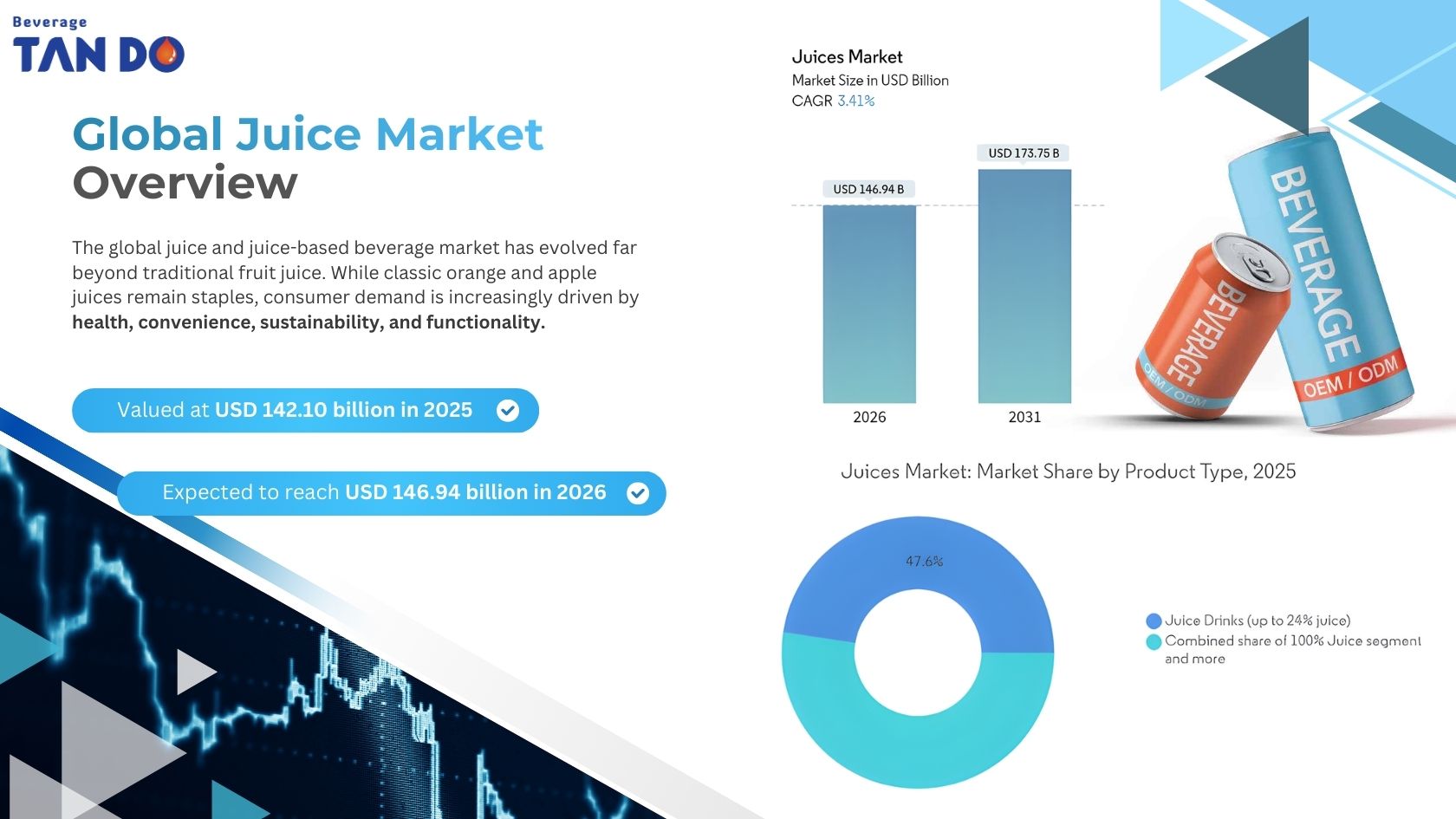
    The global juice and juice-based beverage market has evolved far beyond traditional fruit juice. While classic orange and apple juices remain staples, consumer demand is increasingly driven by health, convenience, sustainability, and functionality.

    In 2025, the global juices market was valued at approximately USD 142.10 billion, and it is projected to reach about USD 146.94 billion in 2026—reflecting an ongoing recovery and expansion in demand for both traditional and value-added juice products. 

    Another forecast shows the fruit juice segment alone reaching roughly USD 165.56 billion in 2025, increasing to around USD 171.69 billion in 2026, driven by healthier lifestyles and rising disposable incomes. 

    Global juice market overview

    This indicates that the global juice market is entering a phase of stable, sustainable growth rather than short-term expansion. For global brands, this creates long-term opportunities for portfolio expansion, product innovation, and strategic OEM/ODM partnerships.

    What’s driving the next wave of growth?

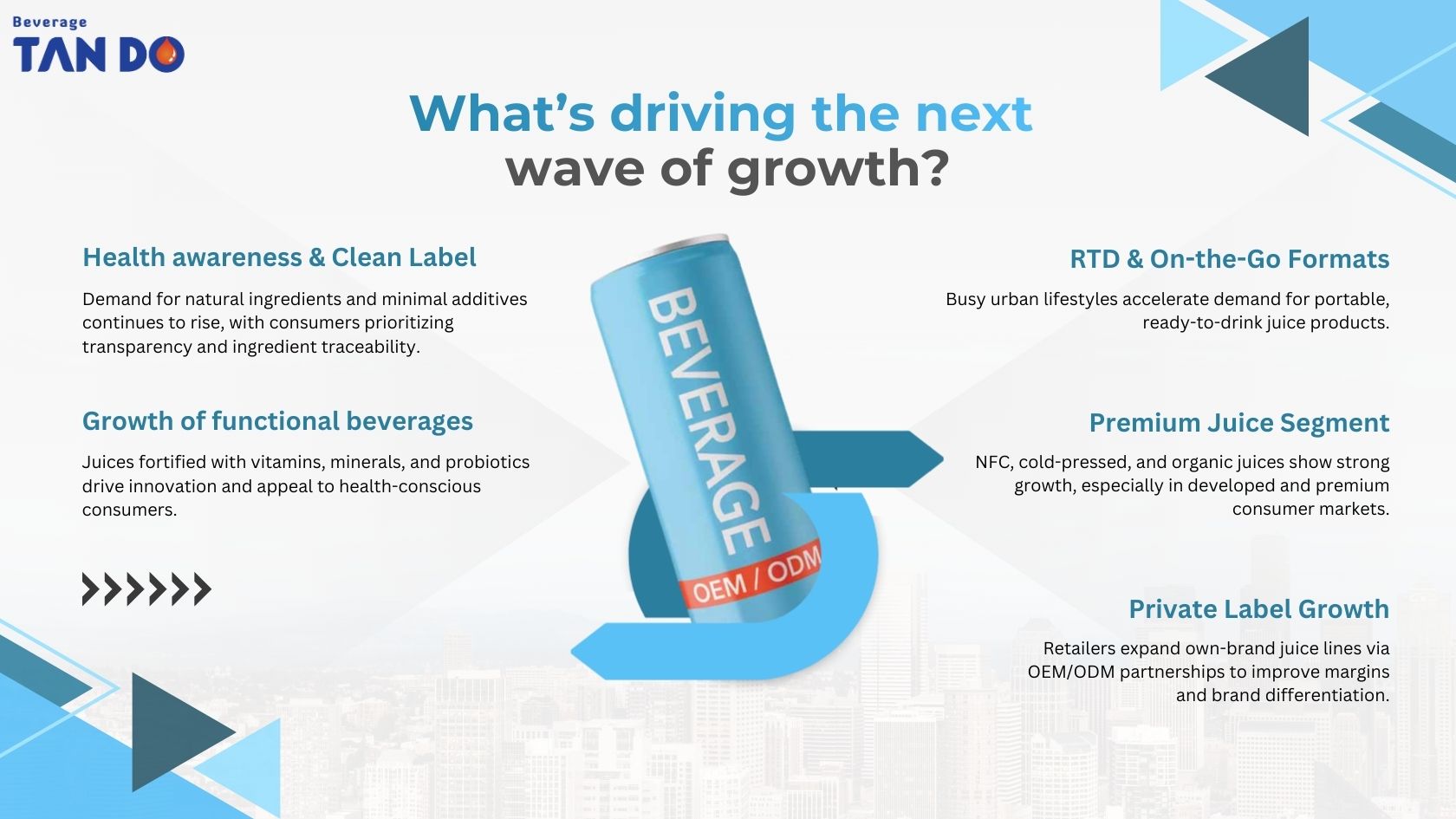
    Several key trends are reshaping the global juice market, driven by:

    • Rising health awareness and demand for natural ingredients: Consumers increasingly seek products with minimal additives and clean labels, boosting demand for juices with natural fruit content and transparent sourcing.
    • Growth of functional beverages: Fortified juices with added vitamins, minerals, and probiotics are driving innovation and attracting health-oriented buyers.
    • Expansion of private label and retailer-owned brands: Retailers are increasingly launching their own juice lines, often developed through OEM/ODM partnerships, to differentiate on quality and price.
    • Increasing demand for ready-to-drink (RTD) and on-the-go formats: Urban lifestyles and convenience culture are major factors in the growth of portable juice formats.
    • Premiumization and demand for NFC, cold-pressed, and organic juices: Higher-end products command stronger growth in developed markets and among affluent consumers.

    What’s driving the next wave of growth

    For more: Beverage Development 2026: What’s Really New in the Beverage Industry? – Tan Do

    The hidden challenges behind juice market growth

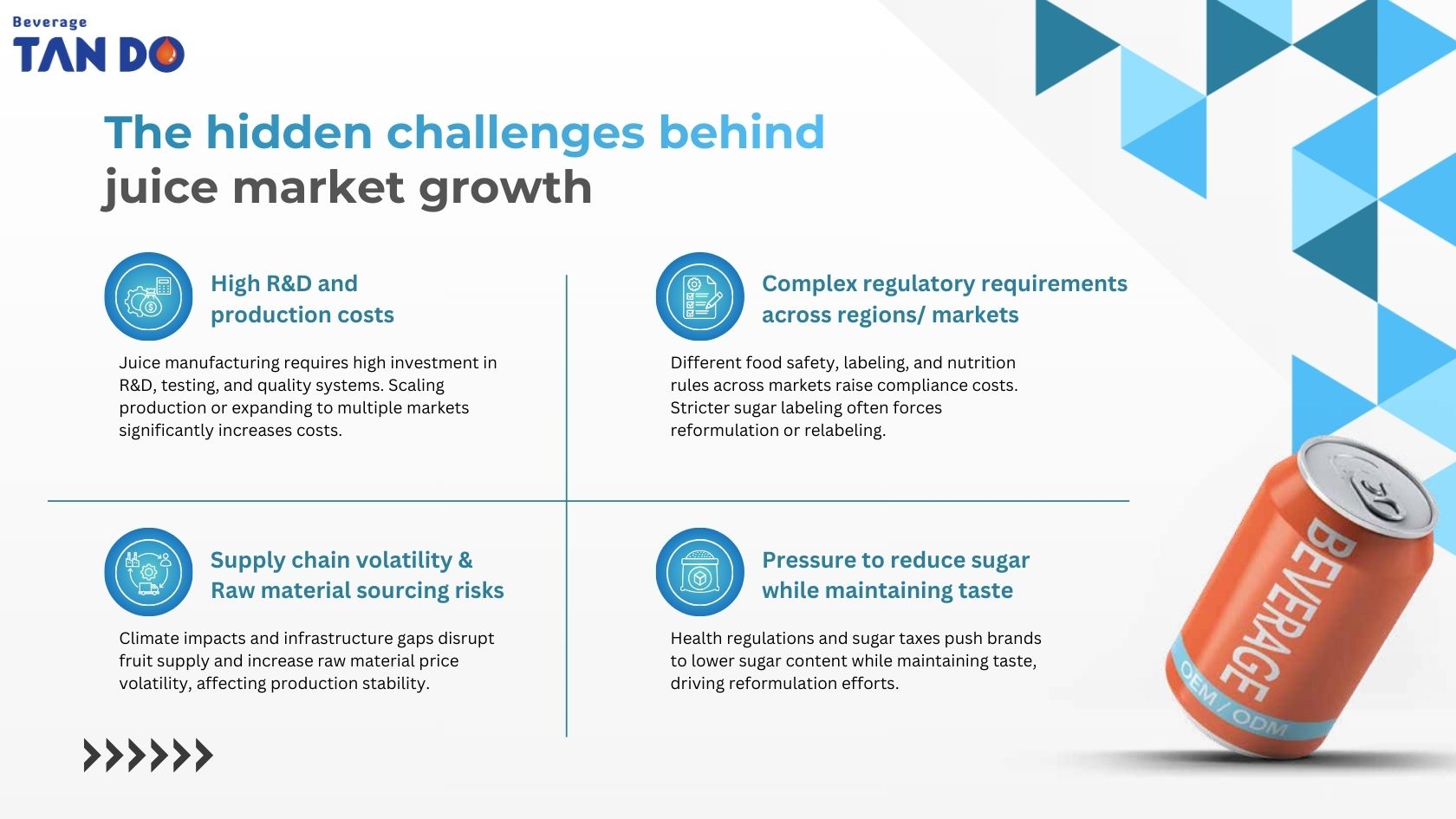
    Despite strong market growth, the global juice industry faces a range of underlying challenges:

    1. High R&D and production costs

    Industry reports consistently indicate that juice manufacturing involves high costs related to R&D, safety testing, and quality management systems, particularly when companies scale production or enter multiple international markets.

    Investments in quality testing infrastructure—including analytical equipment, laboratory facilities, and specialized personnel—represent a major barrier, accounting for a significant share of total production costs for small and medium-sized manufacturers and placing additional pressure on overall R&D budgets.

    This reflects the reality that developing new formulations, conducting extensive testing, and establishing internationally compliant quality control systems require substantial capital investment and skilled human resources.

    2. Complex regulatory requirements across regions/ markets

    Different countries and regions impose distinct standards for food safety, labeling, advertising, and nutritional disclosures, creating additional compliance costs for brands operating across borders. These include expenses related to label revisions, supplementary testing, and repeated product validations.

    • Nutrition labeling regulations—particularly those concerning naturally occurring sugars versus added sugars—are becoming increasingly stringent in many developed markets, forcing brands to reformulate products or update labeling formats.
    • In addition, global food safety frameworks such as Codex Alimentarius, EU regulations, FDA requirements, and HACCP standards demand significant investment in management systems, documentation, and compliance processes.

    This directly aligns with the challenge of complex regulatory requirements across regions in today’s global juice industry.

    3. Supply chain volatility & Raw material sourcing risks

    Market analyses clearly highlight that climate-related disruptions are affecting the supply of key fruit crops such as oranges and apples. Extreme weather events, droughts, and storms in major growing regions have reduced yields and increased raw material costs for juice manufacturers.

    Emerging markets also face challenges related to inadequate cold-chain infrastructure, transportation networks, and cold storage facilities, leading to post-harvest losses and negative impacts on supply chain efficiency.

    These factors contribute directly to supply chain volatility and raw material sourcing risks faced by drink brands.

    4. Pressure to reduce sugar while maintaining taste

    Public health policies—including sugary drink taxes, front-of-pack health warnings, and stricter disclosure requirements for natural versus added sugars—are having a significant impact on the juice industry.

    • In many regions, including the EU and North America, regulations increasingly require clear labeling of added sugars and the expansion of sugar taxation schemes, even as the role of naturally occurring fruit sugars remains a subject of regulatory debate.
    • As a result, brands are compelled to invest in reformulation efforts to reduce sugar content while preserving flavor quality, in order to avoid losing market share due to taxation or negative consumer perception.

    This provides clear evidence of the pressure to reduce sugar while maintaining taste in the global juice market.

    The hidden challenges behind juice market growth

    This is where OEM/ODM juice manufacturers play a critical role—offering technical expertise, operational flexibility, and end-to-end capabilities that enable global brands to navigate regulatory complexity, manage supply chain risks, and respond effectively to evolving consumer demands across international markets.

    Understanding OEM/ODM & Private Label in juice manufacturing

    Before selecting a manufacturing partner, it is essential to understand the distinction between OEM and ODM models and how each supports different brand strategies.

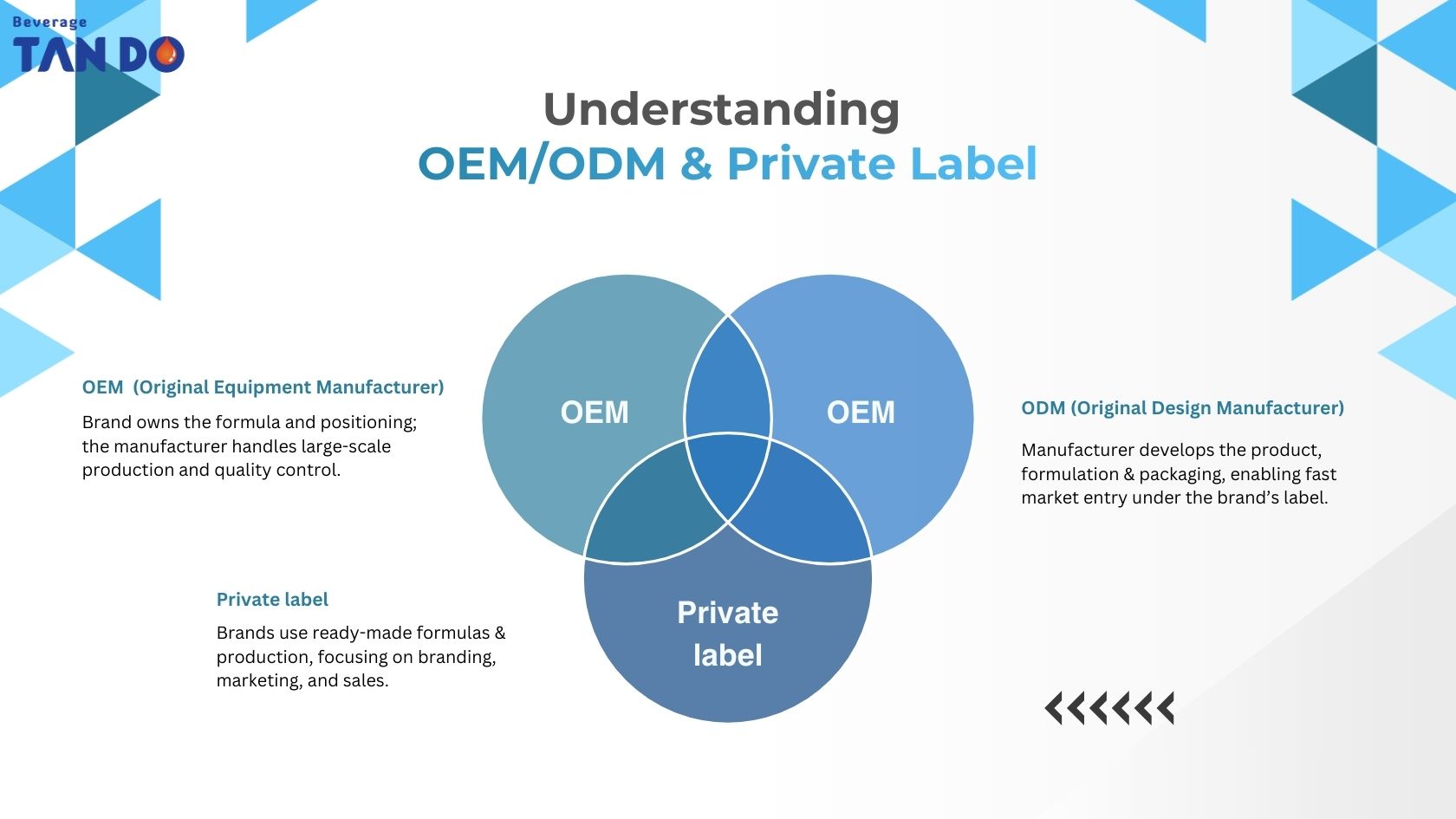
    OEM (Original Equipment Manufacturer)

    OEM focuses on production execution. In this model, the brand owns the formula, specifications, and product positioning, while the manufacturer ensures large-scale production, quality control, and batch consistency. OEM is best suited for established brands with in-house R&D capabilities.

    ODM (Original Design Manufacturer)

    ODM offers a more integrated approach. The manufacturer provides formulation development, ingredient sourcing, packaging recommendations, and regulatory support, enabling brands to launch private-label products with minimal internal development. ODM is ideal for new market entry, private label programs, and trend-driven products.

    Private label

    Private label allows brands to use a manufacturer’s ready-made beverage formula and production setup, while applying their own branding and packaging. In this model, the manufacturer handles product development, and the brand focuses on marketing and selling the product under its own name.

    Understanding OEMODM & Private Label in juice manufacturing

    To learn more about how OEM and ODM services work in practice, click here.

    Why global brands choose OEM/ODM juice manufacturers

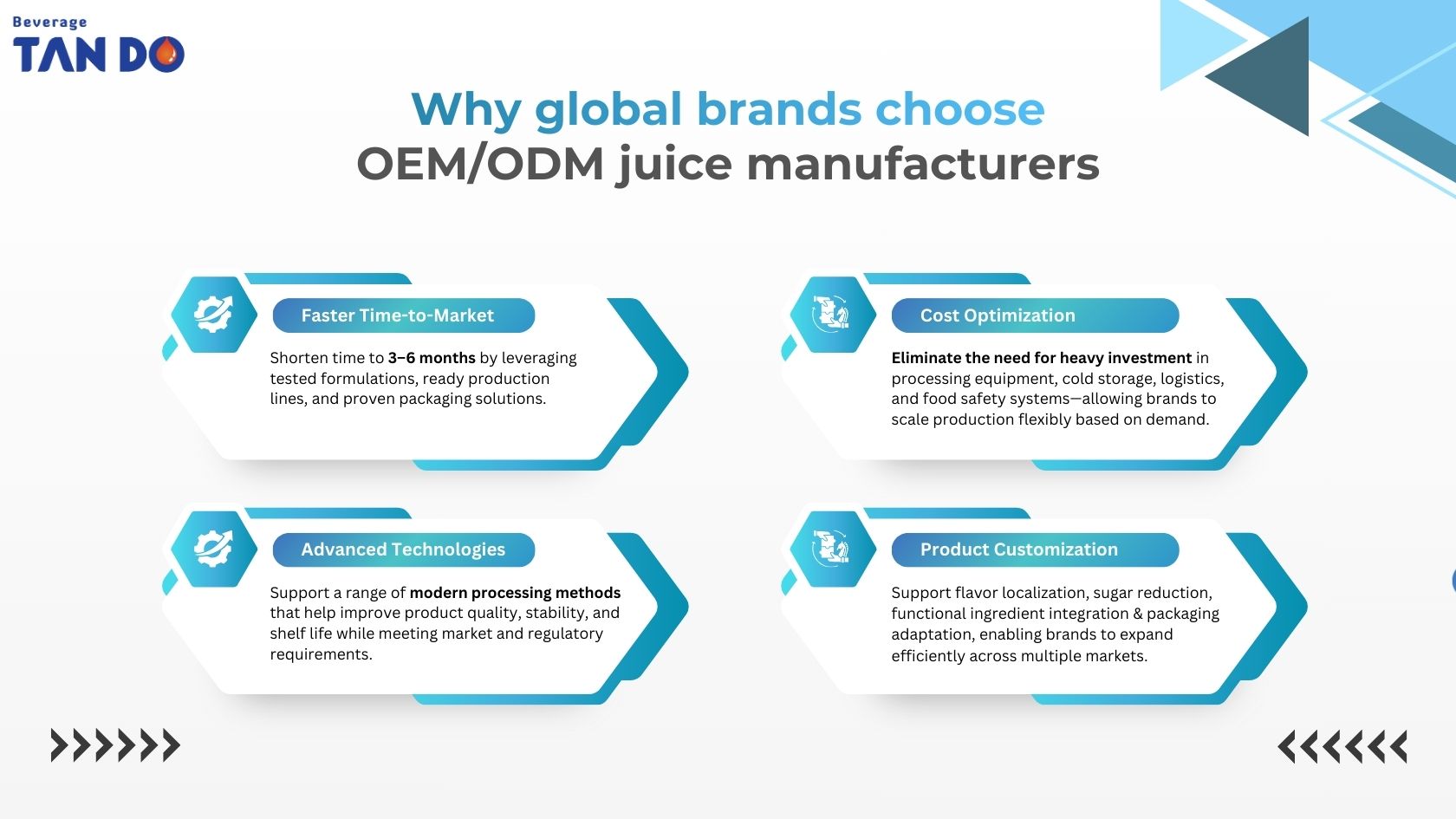
    1. Faster Time-to-Market

    Developing a juice product in-house can take 12–24 months. OEM/ODM manufacturers shorten this to 3–6 months by leveraging tested formulations, ready production lines, and proven packaging solutions.

    2. Cost Optimization and Capital Efficiency

    OEM/ODM partnerships eliminate the need for heavy investment in processing equipment, cold storage, logistics, and food safety systems—allowing brands to scale production flexibly based on demand.

    3. Access to Advanced Processing Technologies

    OEM/ODM manufacturers support a range of modern processing methods that help improve product quality, stability, and shelf life while meeting market and regulatory requirements.

    4. Product Customization for Local Markets

    OEM/ODM manufacturers support flavor localization, sugar reduction, functional ingredient integration, and packaging adaptation, enabling brands to expand efficiently across multiple markets.

    Why global brands choose OEMODM juice manufacturers

    Core capabilities of a reliable OEM ODM juice manufacturer

    Not all juice manufacturers are equipped to support global brands. Selecting the right partner requires careful evaluation of their technical and operational capabilities.

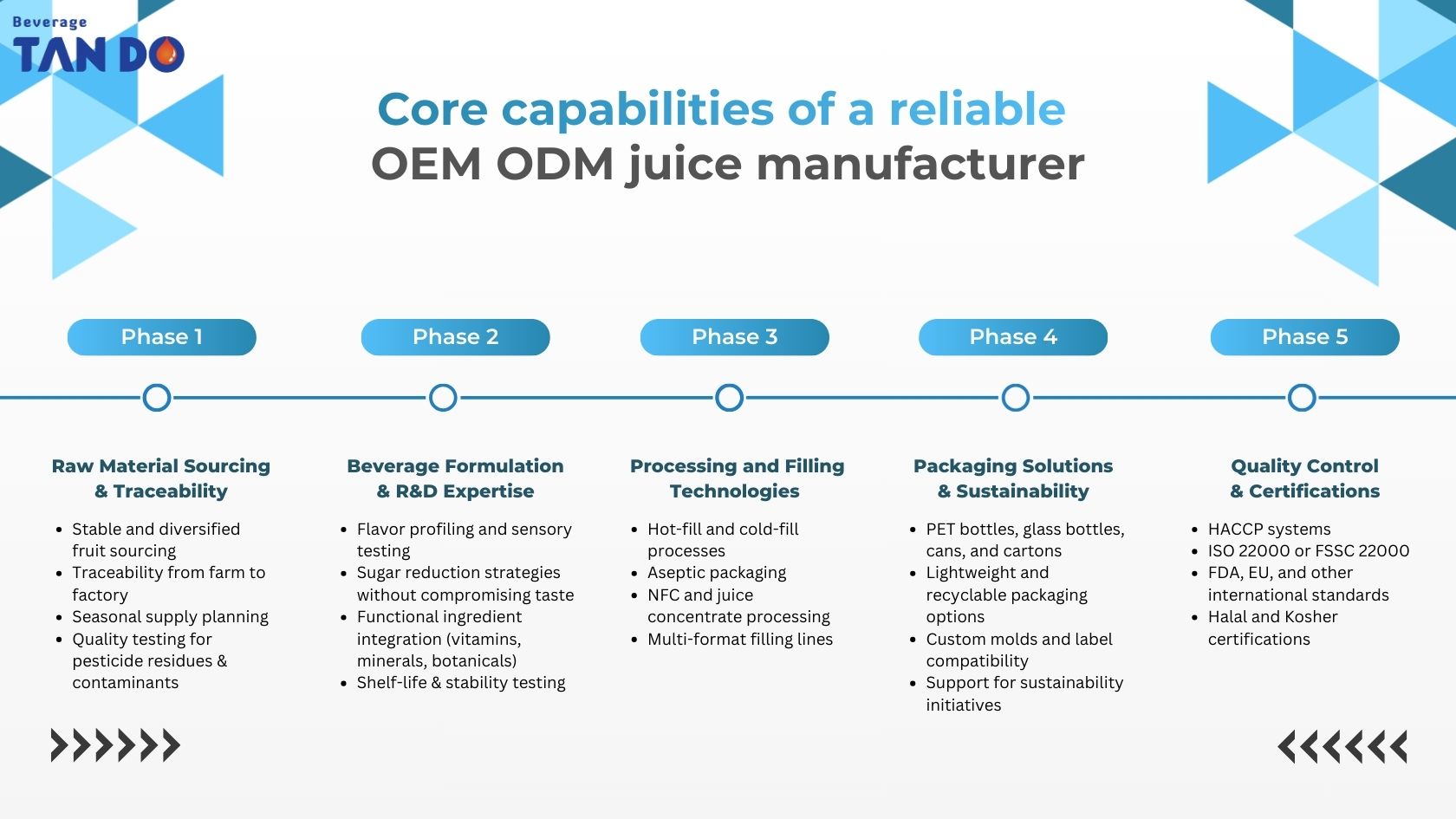
    1. Raw Material Sourcing and Traceability

    High-quality juice starts with high-quality fruit. A reliable OEM/ODM manufacturer should offer:

    • Stable and diversified fruit sourcing
    • Traceability from farm to factory
    • Seasonal supply planning
    • Quality testing for pesticide residues and contaminants

    Strong sourcing capabilities help mitigate supply chain risks and ensure consistent taste.

    2. Beverage Formulation and R&D Expertise

    Advanced R&D capabilities are a key differentiator. Look for manufacturers that provide:

    • Flavor profiling and sensory testing
    • Sugar reduction strategies without compromising taste
    • Functional ingredient integration (vitamins, minerals, botanicals)
    • Shelf-life and stability testing

    This enables brands to create differentiated products aligned with market trends.

    3. Processing and Filling Technologies

    Different products require different processing methods. A comprehensive OEM/ODM juice manufacturer should support:

    • Hot-fill and cold-fill processes
    • Aseptic packaging
    • NFC and juice concentrate processing
    • Multi-format filling lines

    Technology flexibility allows brands to diversify their portfolios.

    4. Packaging Solutions and Sustainability

    Packaging is both a functional and marketing tool. Leading manufacturers offer:

    • PET bottles, glass bottles, cans, and cartons
    • Lightweight and recyclable packaging options
    • Custom molds and label compatibility
    • Support for sustainability initiatives

    Sustainable packaging is increasingly important for global retailers and consumers.

    5. Quality Control and Certifications

    For global distribution, compliance is non-negotiable. Reputable juice manufacturers operate under:

    • HACCP systems
    • ISO 22000 or FSSC 22000
    • FDA, EU, and other international standards
    • Halal and Kosher certifications when required

    Robust quality control protects brand reputation and reduces risk.

    Core capabilities of a reliable OEM ODM juice manufacturer

    How Global Brands Should Choose an OEM/ODM Juice Partner

    When evaluating potential partners, brands should consider:

    • Export experience and client portfolio
    • R&D and innovation capability
    • Production capacity and scalability
    • Quality systems and certifications
    • Communication and project management

    A strong OEM/ODM partner acts as an extension of the brand’s internal team.

    Partner with Tan Do for OEM/ODM Juice Manufacturing Solutions

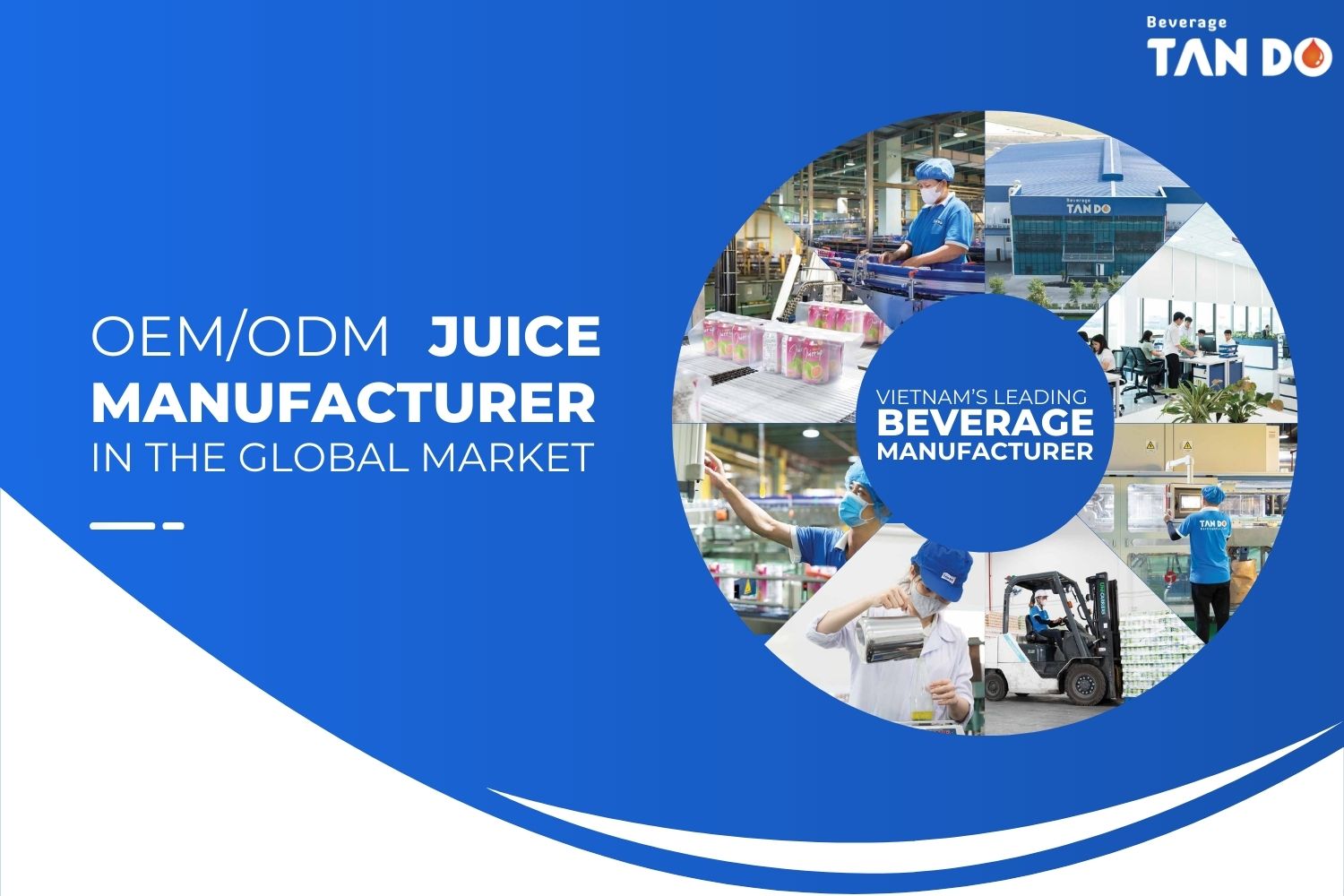
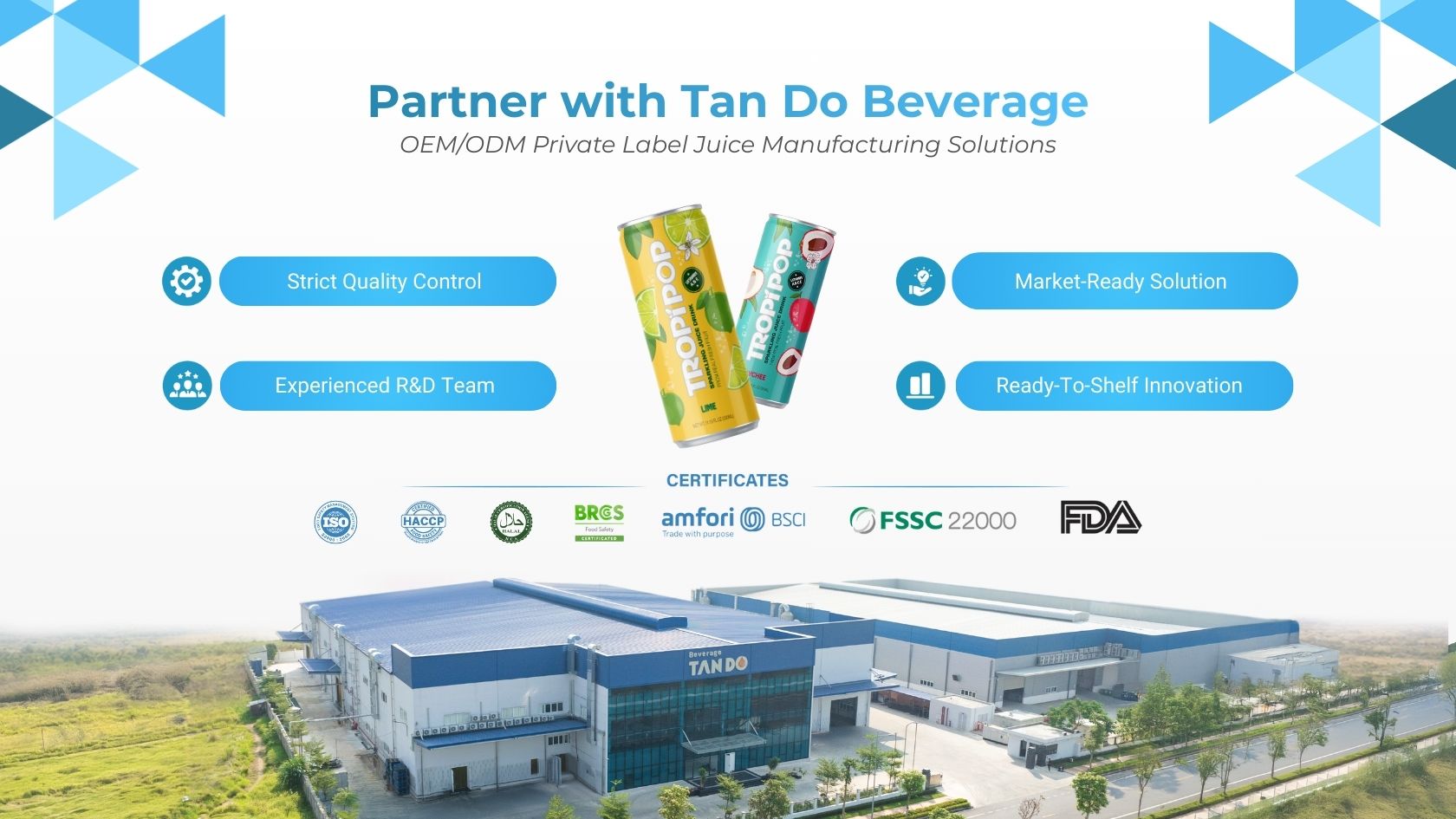
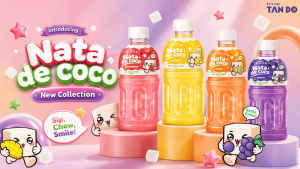
    As one of top juice manufacturers in Vietnam with OEM/ODM solutions for global brands, Tan Do offers end-to-end beverage manufacturing services—from formulation and sourcing to production, packaging, and export support.

    Partner with Tan Do for OEMODM Juice Manufacturing Solutions

    With strong R&D capabilities, international quality certifications, and experience serving global markets, Tan Do is committed to helping brands launch and scale high-quality juice products efficiently and reliably.

    Contact Tan Do today to explore how our OEM/ODM juice manufacturing solutions can support your global brand’s growth.

    Content Protection by DMCA.com
    Phuong Dang

    Leave a Reply

    Your email address will not be published.

    Xác thực trượt *