Clean label is no longer a new concept in the food and beverage industry, but by 2026 it has entered a new phase—shifting from a “nice-to-have trend” to a baseline consumer expectation.
As consumers grow increasingly cautious about processed foods, labels are no longer just a space for mandatory information; they have become a critical trust touchpoint between brands and buyers. In the beverage category, where purchase decisions are often made in seconds, a clean labels play a decisive role in creating immediate reassurance at first glance.
What is Clean Label: Why There’s No Single Definition
Clean label is one of the few concepts in the food and beverage industry shaped almost entirely by consumer perception rather than by formal legal frameworks. To date, there is no globally recognized legal definition that applies uniformly to clean labels. Its meaning varies widely depending on market maturity, cultural context, and local consumption habits.
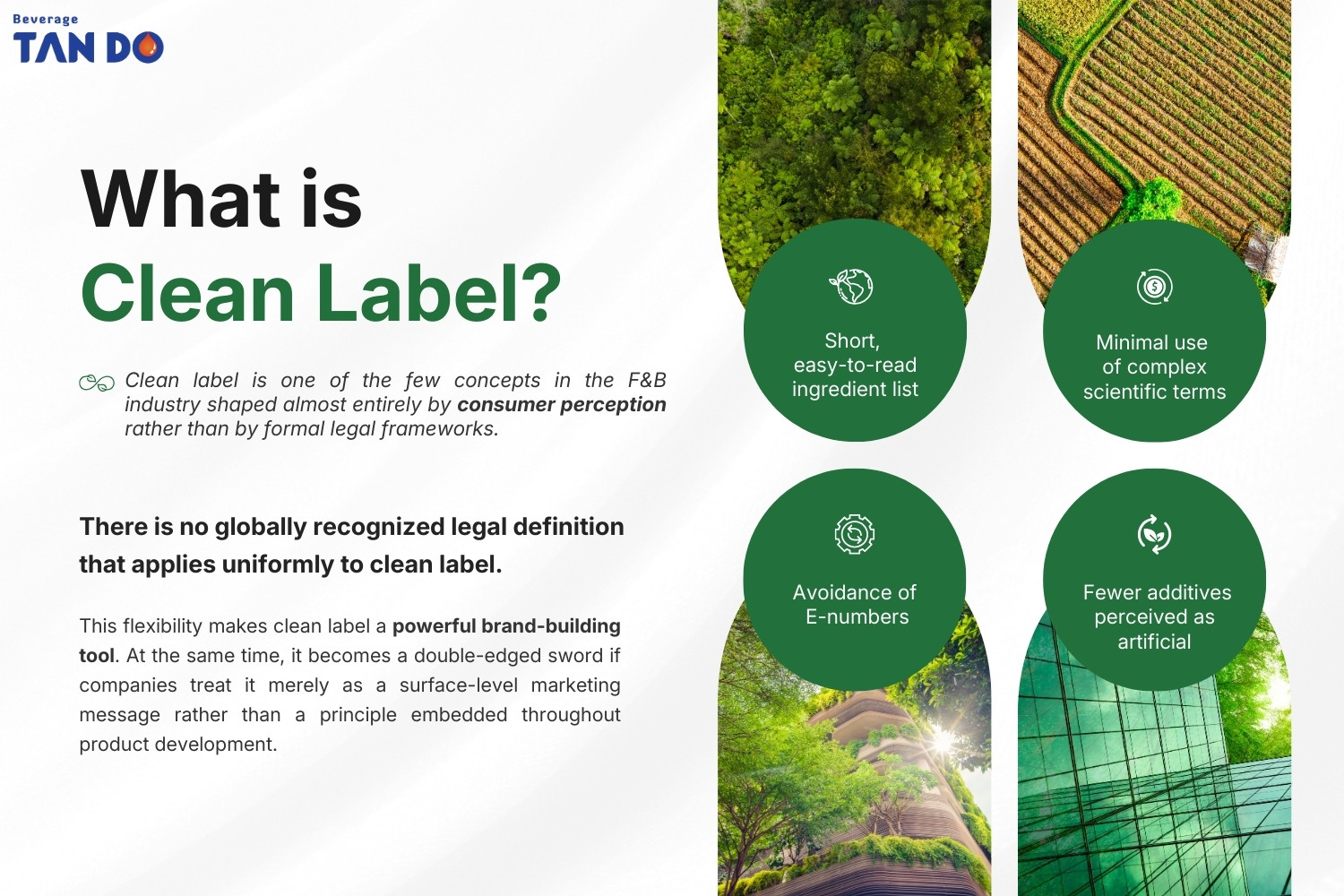
For most consumers, clean labels typically implies a short, easy-to-read ingredient list, minimal use of complex scientific terms, avoidance of E-numbers, and fewer additives perceived as artificial. This flexibility makes it a powerful brand-building tool. At the same time, it becomes a double-edged sword if companies treat it merely as a surface-level marketing message rather than a principle embedded throughout product development.
Examples
| Regular Label | Clean Label |
| INGREDIENTS:
Water, sugar, fruit juice concentrate (mango), acidity regulator (citric acid – E330), artificial flavour (mango), colour (sunset yellow – E110), preservative (sodium benzoate – E211), stabilizer (xanthan gum – E415) |
INGREDIENTS:
Water, mango juice (from concentrate), sugar, lemon juice, natural mango flavour, ascorbic acid (vitamin C) |
Clean Label Is Not Outside the Scope of Regulation
A common misconception is that because clean label lacks a clear legal definition, companies are free to use the term without restriction. In reality, the opposite is true. In Europe, general food information principles still fully apply to clean label claims. All information presented on food labels must be accurate, clear, and not misleading regarding the nature or characteristics of the product.
Highlighting claims such as “no preservatives” or “no artificial colors” in categories where these additives are already prohibited by law may be considered misleading to consumers. This reinforces the fact that a clean label is not a legal “grey zone,” but remains subject to strict oversight through fair and truthful information practices.
Some countries are moving even further. Belgium, for example, has proposed a definition of clean label that excludes E-numbers and the legal names of food additives altogether. This initiative signals a broader regulatory shift, where authorities are beginning to treat it as an area requiring clearer control, rather than leaving it solely as a marketing-driven concept.
What Consumers Are Really Looking for in Clean Label Products
At its core, clean label is driven by a fundamental need: trust. The figures showing that nearly 3 in 4 consumers reconsider purchases based on ingredient lists, while 58% emphasize the importance of clear information about ingredients and sourcing, reflect a broader shift in consumer decision-making behavior observed across multiple global consumer insight studies.
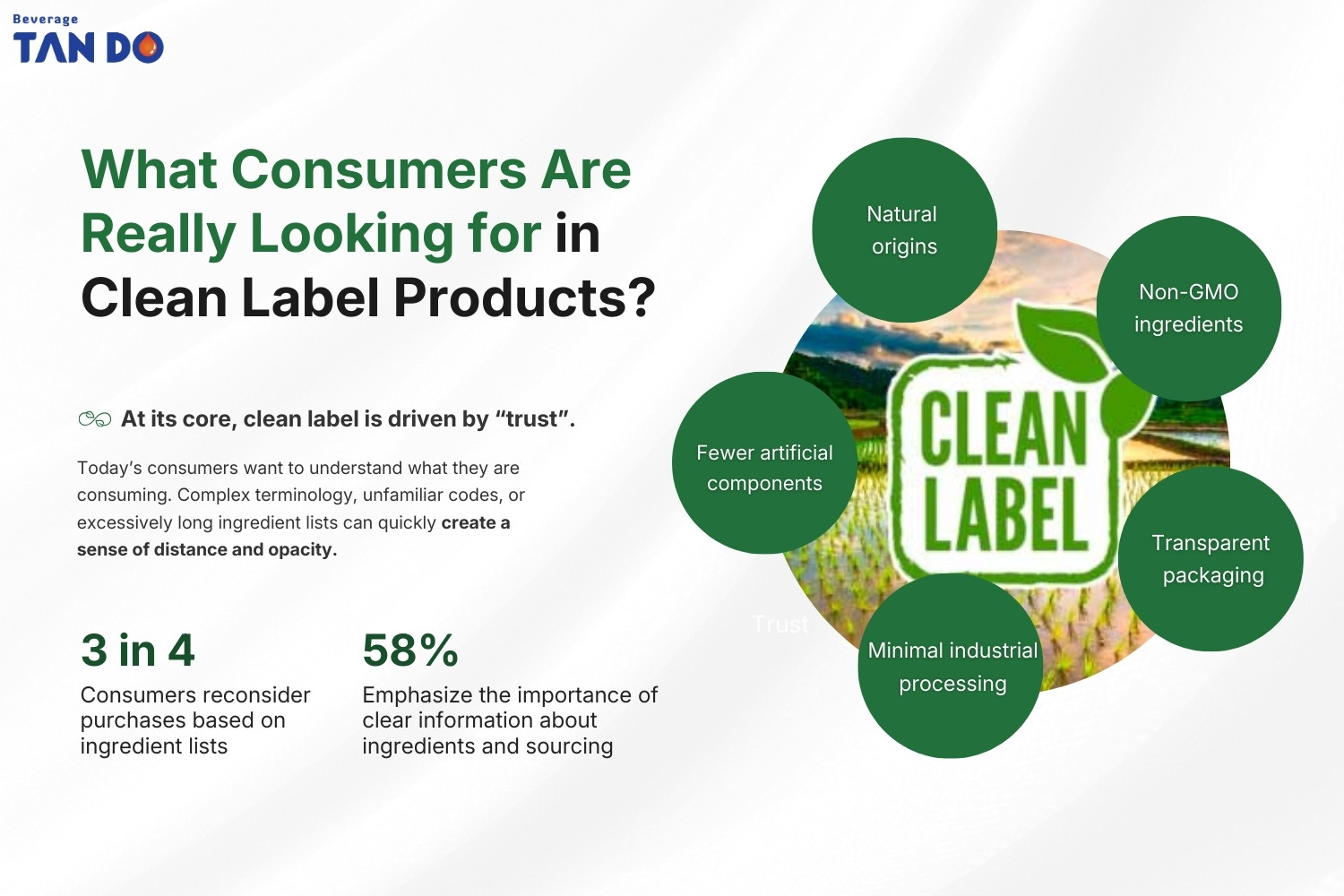
Today’s consumers do not necessarily demand products that are perfect or completely free from additives, but they do want to understand what they are consuming. Complex terminology, unfamiliar codes, or excessively long ingredient lists can quickly create a sense of distance and opacity.
From a consumer perspective, an ideal clean label is one they can read and understand without specialized knowledge. They tend to favor products with natural origins, fewer artificial components, non-GMO ingredients, minimal industrial processing, and packaging that communicates transparency. It is important to note that this perception of “clean” is highly psychological—one inconsistency or unclear detail can easily undermine the trust a brand has worked hard to establish.
Clean Label in the Beverage Industry: A Formula and Technology Challenge
In the beverage sector, clean label goes far beyond simply removing additives. It is a holistic challenge involving formulation design, ingredient selection, and processing technologies. Many manufacturers are shifting toward plant-based ingredients, natural extracts, or traditional processes such as fermentation to achieve functional performance comparable to that of synthetic additives.
Clean label trends show a strong shift toward plant-based ingredients, which consumers increasingly associate with naturalness and functionality. More than 1 in 3 consumers say they are willing to try new or novel ingredients if they contribute to a more natural product.
Natural sweeteners such as monk fruit, often blended with allulose, stevia, or date syrup, are gaining momentum globally. With recent regulatory changes allowing broader use in the UK and EU, beverage brands are aligning formulations across markets to meet clean label expectations without compromising taste.
Still, clean label does not automatically mean “additive-free.” In many cases, additives still exist but are embedded within substitute ingredients, such as vegetable extracts or fermented vinegars. This raises important questions about the boundary between transparency and the creation of a “natural” impression, and places greater responsibility on brands to communicate honestly and thoughtfully with the market.
Label Language: Small Details, Big Impact
The way ingredients are named can strongly influence how consumers perceive a product’s clean label status. Consumers increasingly want simple, real, and recognizable ingredients they can understand.
Familiar terms such as “baking soda” tend to feel more approachable than “sodium bicarbonate,” even though they refer to the same substance. Similarly, “vitamin E” is generally more acceptable to consumers than “tocopherol,” despite being chemically identical. This explains why brands are experimenting with front-of-pack messaging that highlights ingredient count or avoids overly technical phrasing—while still remaining legally compliant.
However, companies do not always have full freedom in choosing label language. Many regulations require the use of precise scientific or legal ingredient names, making it more complex to balance regulatory compliance with consumer-friendly communication. This is where clean label demands a deep understanding of both legal requirements and consumer psychology.
Packaging and Transparency
Clean labels do not stop at the ingredient list. Packaging plays a critical role in communicating transparency and honesty. Consumers are increasingly sensitive to packaging designs that feel misleading, such as unnecessary empty space in bottles or cartons. At the same time, recyclability, material sourcing, and the ability to see the product inside all contribute to reinforcing a clean label image.
From this perspective, clean label is not solely an R&D or marketing concern—it is a holistic strategy that spans packaging design, supply chain decisions, and overall brand integrity.
Global Shifts: What the Data Shows
Globally, around 30% of new food and beverage launches now feature a clean label claim, with no additives or preservatives leading at 14% penetration. Ethical and environmental claims are the fastest growing, showing a 15% CAGR over the past five years (Innova Market Insights)
Regional dynamics differ:
- Australasia leads globally, with 49% of launches carrying clean label claims
- North America emphasizes GMO-free positioning
- Europe focuses more on ethical, environmental, and organic claims
- Asia has seen a 3% year-on-year increase, signaling rising momentum

This trend is especially pronounced in categories such as nutritional beverages, children’s products, and plant-based drinks. Beyond the absence of additives, clean label is increasingly expanding to encompass broader values including ethics, environmental responsibility, traceability, and sustainability.
Consumers are no longer asking only what is inside a product—they want to know how it is made, where the ingredients come from, and what impact it has on the environment. This shift signals that clean label has become part of a wider consumer value system, rather than a standalone product attribute.
Misconceptions and Business Challenges
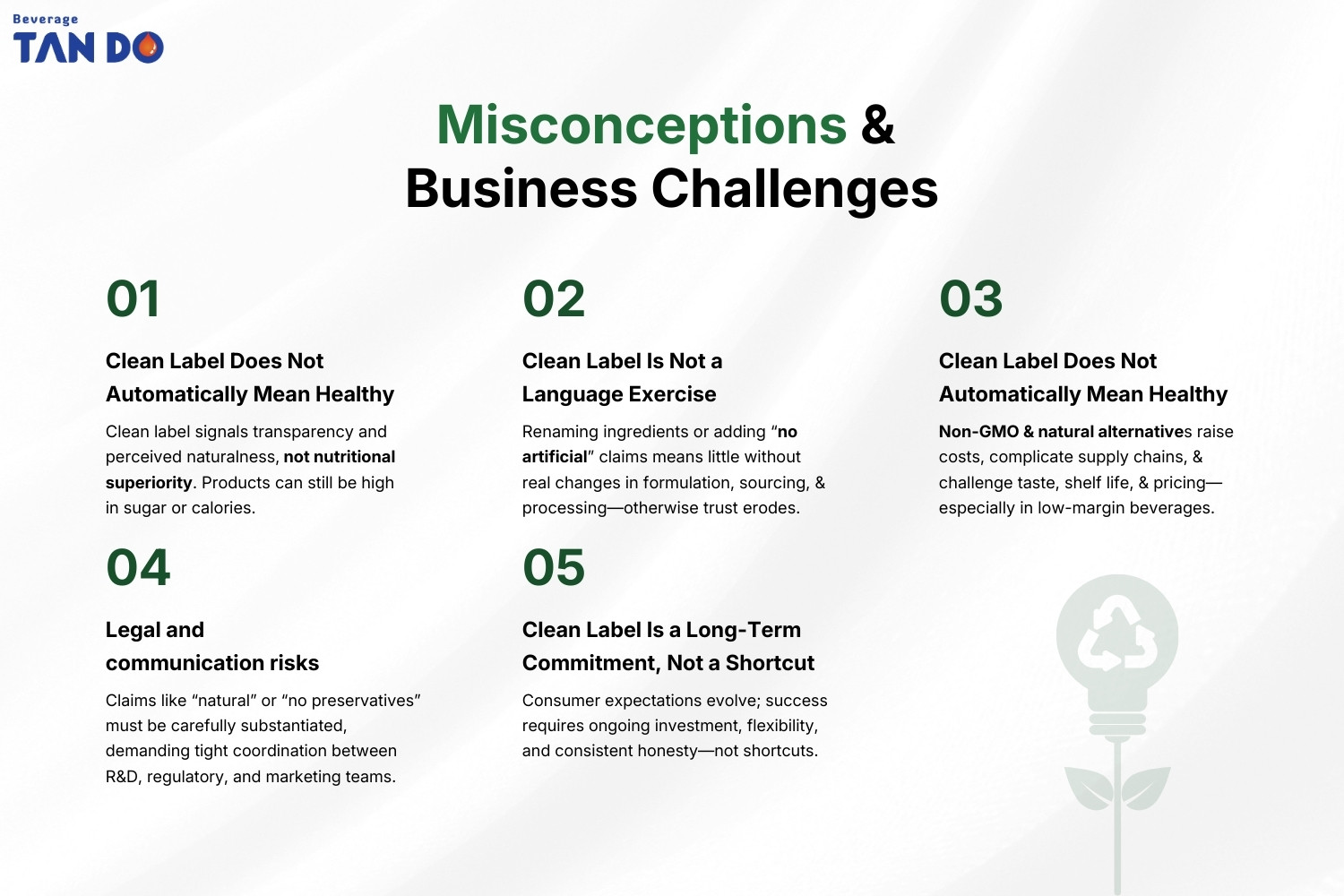
1. Clean Labels Do Not Automatically Mean Healthy
One of the most widespread misconceptions is the belief that a clean label product is inherently “healthy.” In reality, clean label reflects transparency and perceived naturalness, not nutritional quality.
A product with a short, easy-to-read ingredient list can still contain high levels of sugar, calories, or lack overall nutritional balance. Equating clean label with health not only misleads consumers, but also places unrealistic and inaccurate communication pressure on brands.
2. Clean Label Is Not a Language Exercise
Another common misunderstanding—particularly on the brand side—is treating clean label as a wording solution rather than a product strategy. Changing ingredient names, reducing E-numbers, or emphasizing “no artificial” claims means very little if the formulation, raw materials, and production processes behind the product remain unchanged. When the gap between marketing claims and actual product reality becomes too wide, the risk of eroding consumer trust rises sharply—especially as shoppers become more proactive in reading and comparing labels.
3. The Cost and Complexity of R&D
From an operational perspective, the biggest challenge in pursuing clean label lies in R&D investment and technical complexity. Non-GMO ingredients, natural extracts, plant-based stabilizers, and alternative sweeteners often come with higher costs, less stable supply chains, and stricter quality control requirements. In the beverage industry—where margins are already thin—balancing clean label expectations with taste performance, shelf life, and competitive pricing becomes a particularly difficult equation.
4. Legal and Communication Risks
Clean labels also introduce significant regulatory and communication challenges. Claims such as “natural,” “no preservatives,” or “clean ingredients” may resonate strongly with consumers, but they must be used carefully to avoid legal grey areas or accusations of misleading messaging. This reality demands close coordination between R&D, regulatory, and marketing teams—an organizational maturity that not every beverage company is prepared to support.
5. Clean Label Is a Long-Term Commitment, Not a Shortcut
Finally, clean label is not a fixed destination, but an ongoing journey. Consumer expectations continue to evolve, and what qualifies as “clean” today may feel outdated in just a few years. Brands that pursue clean label must view it as a long-term commitment—requiring flexibility, sustained investment, and above all, consistent honesty with the market.
Sum Up
As the industry moves toward 2026, clean label is no longer about chasing trends. It has become a benchmark for brand responsibility, R&D capability, and overall maturity. The brands that succeed will be those that truly understand the essence of clean labels and implement it consistently—from formulation and packaging to communication—while maintaining long-term honesty with consumers.
Ultimately, it is not about making products appear “cleaner.” It is about building transparent, credible, and sustainable relationships with the market.
You may also like:
Key Drink Trends in 2026: Toppings, Foam, and Texture
Beverage Development 2026: What’s Really New in the Beverage Industry?